Coffee Machines 5 Coffee Grinders for Even Pour-Over Grounds
P
By the Pickpedia Team
·5 picks compared
·Last verified September 2026
Affiliate disclosure: As an Amazon Associate, Pickpedia earns from qualifying purchases. Links on this page are paid links, and we may earn a commission at no extra cost to you. This never affects our picks or scores.
Quick answer
For even pour-over grounds, a burr grinder wins over blades because it produces uniform particles. Manual burr models suit slow mornings and travel, while compact electric burr grinders speed up daily brewing. Blade grinders work in a pinch but scatter particle sizes, so pick burrs when consistency matters most.
5 Coffee Grinders for Even Pour-Over Grounds at a glance
Why you can trust this guide
We compared these picks using verified manufacturer specifications, available manuals and documentation, current retailer listings, and patterns in owner feedback, alongside editorial research. We focus on measurable differences such as performance, capacity, usability, and build quality. Pickpedia does not present editorial research as laboratory testing, and we do not claim hands-on testing unless it was actually performed.
How we chose: We compared five coffee grinders across burr type, grind settings, capacity, and cleaning ease, focusing on how evenly each handles pour-over grounds.
Pour-over rewards a steady, even grind, and the grinder does most of that work before water ever touches the beans. Uneven particles pull bitter and sour notes into the same cup, which is why grind consistency sits at the top of this list. Burr designs, whether ceramic or stainless steel, crush beans to a more uniform size than spinning blades.
This roundup mixes manual and electric options so you can match a grinder to your routine. Some reward patience and portability, others prioritize speed on a busy counter. Every claim here draws on the listed specifications and features, along with what reviewers and owners commonly report, so you can judge fit before buying.
Our top picks
CEVING takes a different route with 40 external grind settings, so an adjustment ring lets you dial in pour-over territory without opening the grinder. Conical ceramic burrs run cooler than blades and give a more uniform grind, which reviewers note helps preserve delicate flavor. At 325g and roughly 6.7 by 2.3 by 7.4 inches, it slips into a bag for camping, travel, or the office. Three main parts pull apart for quick cleaning with the included brush. The 30g capacity handles a cup or two per grind, but larger batches mean repeated cranking, so heavy household use points toward an electric model.
Burr typeConical ceramic
Grind settings40 external
Capacity30g beans
Weight325g
Pros
- 40 external settings make pour-over dialing simple
- Ceramic burrs grind cool and uniform
- Light and genuinely portable
Cons
- Small 30g capacity slows big batches
- Manual cranking takes effort and time
Check price on Amazon ›
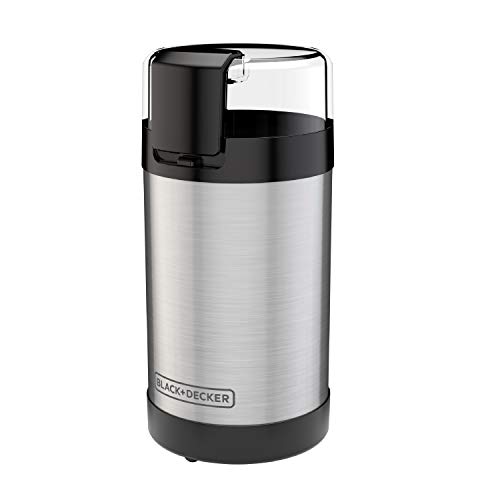
BLACK+DECKER keeps things simple with stainless steel blades and a one-touch push button that runs only while you press it. That timing trick lets you nudge the result from coarse to fine, and the brand cites markedly better grinding uniformity than older units. Beyond coffee, the blades handle herbs, spices, and grains, so it doubles as a kitchen multitasker. A lid-locking safety feature keeps the blades still until the lid seats. Honest caveat: blade grinders chop rather than crush, so particle size stays less even than burr models, and pour-over purists may notice the difference in the cup.
Grinding mechanismStainless steel blades
ControlOne-touch push button
SafetyLid-locking feature
Extra usesHerbs, spices, grains
Pros
- One-button operation is beginner friendly
- Doubles for spices and grains
- Lid lock adds a safety layer
Cons
- Blades grind less evenly than burrs
- Timing by hand takes practice for pour-over
Check price on Amazon ›
SHARDOR leans on a timed rotary knob, marked in seconds from coarse to fine, so you control grind by run time rather than a fixed setting. Owners point to its quiet operation, with an average around 63 dB that stays gentle for early mornings. The removable cup grinds up to 2.5 ounces of beans, enough for roughly ten cups, and lifts out for tidy pouring. Like other blade units, it also tackles dry spices, quinoa, rice, and more. The honest limit is consistency: timing gives approximate results, and blades cannot match a burr grinder's even particle size for exacting pour-over work.
Grinding mechanism2-blade cup
ControlTimed rotary knob
Capacity2.5oz beans
Noise levelAbout 63 dB
Pros
- Runs quietly for early mornings
- Removable cup pours cleanly
- Larger batch capacity than most blade units
Cons
- Timed grinding gives approximate results
- Blades trail burrs on evenness
Check price on Amazon ›
OXO fits real burr precision into a slim frame, standing about 11 inches tall and 4 inches wide so it tucks into tight counters or a cabinet. Stainless steel conical burrs drive the grind quality, and 15 settings plus 29 micro-adjustments let you fine-tune toward the pour-over sweet spot. It holds up to 50 grams of beans, enough for roughly six cups or 30 ounces at a time. Both burrs lift out for thorough cleaning, which keeps old grounds from staling fresh batches. Its footprint keeps capacity modest, so households brewing large pots repeatedly may want something with a bigger hopper.
Burr typeStainless steel conical
Grind settings15 plus 29 micro-adjust
Capacity50g beans
Dimensions11in tall, 4in wide
Pros
- Slim body suits small counters
- Micro-adjustments dial in pour-over
- Removable burrs clean thoroughly
Cons
- Modest hopper for large households
- Fewer coarse-grind cups per fill
Check price on Amazon ›
KIDISLE offers 35 grind settings across a conical burr mechanism, spanning fine espresso to coarse French press with pour-over sitting comfortably between. A large transparent hopper and ground container let you watch levels and grinding progress at a glance, which helps you portion without guessing. Its anti-static design aims to cut the clingy mess that scatters fine grounds around the counter. A simple dial picks grind size and amount, and removable parts make cleaning routine. One honest note: static reduction helps but rarely eliminates fine-grind clumping entirely, so a light tap of the container is still handy before you brew.
Burr typeConical burr
Grind settings35 sizes
DesignAnti-static, transparent hoppers
ControlSingle dial
Pros
- 35 settings cover many brew methods
- Clear hoppers show levels easily
- Anti-static design curbs mess
Cons
- Static control is not fully eliminated
- Dial portioning takes some learning
Check price on Amazon ›
What to look for
Why burrs beat blades for pour-over
Pour-over extraction depends on even particle size, and burrs crush beans to a consistent grind that water flows through predictably. Blades chop randomly, mixing dust and boulders that over and under extract at once. If a clean, balanced cup is the goal, a conical burr grinder gives you the steadiest foundation.
Manual versus electric
Manual grinders reward patience with quiet operation, portability, and cooler ceramic burrs, making them ideal for travel or single cups. Electric burr models trade some counter space for speed and larger hoppers, which suits daily multi-cup brewing. Choose based on how many cups you make and whether portability matters more than pace.
Dialing in the right grind size
Pour-over generally lands at a medium grind, coarser than espresso and finer than French press. Grinders with more settings or micro-adjustments let you shift by small steps to chase clarity and flow rate. Start medium, taste, then move one step finer for more body or coarser to slow a sour, fast brew.
Cleaning and static control
Old grounds go stale and taint fresh coffee, so pick a grinder with removable burrs or parts for regular cleaning. Ceramic burrs often clean with a dry brush rather than water. Fine grinds also cling from static, so anti-static designs and a gentle tap of the catch cup keep your counter and dose tidy.
Frequently asked questions
Is a burr grinder really better for pour-over?
Yes, burrs produce a more uniform grind than blades, and even particles are what let pour-over water extract cleanly. Blade grinders can work in a pinch, but they scatter particle sizes, which tends to muddy the cup.
What grind size should I use for pour-over?
Aim for a medium grind, roughly like coarse sand, sitting between espresso and French press. Adjust from there by taste: finer for more body, coarser if the brew runs fast and sour.
Are manual grinders worth the extra effort?
For single cups, travel, or quiet mornings, many drinkers find the tradeoff worthwhile. Ceramic burrs grind cool and even, though larger batches mean noticeably more cranking than an electric model.
How many settings do I actually need?
Any grinder with clear steps from fine to coarse can cover pour-over. More settings or micro-adjustments simply let you fine-tune extraction in smaller increments as your palate sharpens.
Can these grinders handle spices too?
Several blade models here explicitly grind herbs, spices, and grains alongside coffee. Dedicating one grinder to coffee is wise, though, since spice oils can linger and flavor your beans.
How do I keep grounds from clinging everywhere?
Anti-static designs help, and a light tap of the catch cup releases most clingy fines. Grinding into a slightly damp or grounded container also reduces the mess with fine settings.
Should I clean the burrs, and how often?
Clean regularly to stop stale grounds from tainting fresh coffee. Removable burrs make this easy, and ceramic types often prefer a dry brush over water to protect flavor.
Which capacity suits a household?
Compact burr grinders here hold enough for several cups per fill, while manual units suit one or two cups at a time. For frequent large batches, favor the models with bigger hoppers.
The verdict
CEVING Mini Manual Coffee Grinder With 40...
9.1/10
For most pour-over drinkers, the CEVING earns Best Overall with 40 external settings and cool ceramic burrs in a truly portable body. Tight counters are best served by the OXO, whose slim frame still delivers real burr precision and micro-adjustments. Daily multi-method brewers will like the KIDISLE and its 35 settings, while the SHARDOR suits quiet early mornings and the BLACK+DECKER keeps things simple for newcomers.
Check price on Amazon ›
Our top pick, secure checkout via Amazon
Note: Availability and specifications change often. Always confirm the current details on Amazon before buying.