Tools & DIY 5 Drywall Sanders for Smooth, Dust-Free Walls Fast
P
By the Pickpedia Team
·5 picks compared
·Last verified September 2026
Affiliate disclosure: As an Amazon Associate, Pickpedia earns from qualifying purchases. Links on this page are paid links, and we may earn a commission at no extra cost to you. This never affects our picks or scores.
Quick answer
For most walls and ceilings, a powered pole sander with strong dust extraction and a rotating head does the heavy lifting fastest. Pick higher wattage and adjustable speed for tough putty. Hand sanding sponges still earn a spot for corners, touch-ups, and jobs where a machine is overkill.
5 Drywall Sanders for Smooth, Dust-Free Walls Fast at a glance
Why you can trust this guide
We compared these picks using verified manufacturer specifications, available manuals and documentation, current retailer listings, and patterns in owner feedback, alongside editorial research. We focus on measurable differences such as performance, capacity, usability, and build quality. Pickpedia does not present editorial research as laboratory testing, and we do not claim hands-on testing unless it was actually performed.
How we chose: We compared five drywall sanding options across power, dust control, reach, and corner access, weighing what actually keeps walls smooth and cleanup light.
Sanding drywall is the messy, tiring step nobody looks forward to, and the tool you choose decides how much dust ends up on the floor. Powered pole sanders speed through large ceilings and walls, while variable speed lets you match aggressiveness to the surface.
This roundup mixes full electric sanders with a simple hand sponge set, because not every project needs a motor. Below we break down power, dust collection, reach, and where each option falls short, all grounded in the listed specifications and what owners commonly report.
Our top picks
Built around a 1.5 HP motor running up to 1700 RPM with five speeds, this VEVOR handles thin putty and aged paint on walls, floors, and ceilings. A 360 degree rotating disc, 90 degree swivel handle, and detachable base help it reach corners and edges. The internal vacuum system pulls dust as you work, and a built-in 360 degree LED lights up shadowy ceilings. Its telescopic pole extends from 4.6 to 5.9 feet, then folds down for storage. One limitation: overhead sessions past a few minutes still tire the arms, so the included shoulder strap matters more than it sounds.
Motor1.5 HP, up to 1700 RPM
Speeds5 adjustable
ReachPole 4.6 to 5.9 ft
Extras360 LED, internal vac, shoulder strap
Pros
- Strong motor tackles thick paint and putty
- Rotating disc and swivel handle reach corners
- Built-in LED and dust system reduce hassle
Cons
- Ceiling work still fatigues the arms over time
- Telescopic reach tops out under 6 feet
Check price on Amazon ›
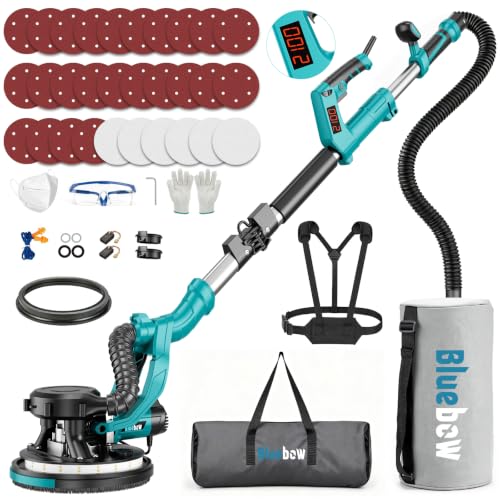
A 1000W pure copper motor spins from 800 to 2100 RPM across nine speeds, so you can dial in loose plaster, painted walls, or cement without guesswork. The digital display shows exact speed readings in daylight or dark corners, and owners point to its claimed 98.5 percent dust extraction as a real cleanliness win. Dual-layer LED lighting, a 360 degree removable edge, and a 120 degree swing rod chase down blind spots and right angles. The aluminum telescopic rod reaches from 4.9 to 6.2 feet. It also ships with plenty of sandpaper and safety gear. Downside: the long rod adds weight overhead, so breaks help on big ceilings.
Motor1000W, 800 to 2100 RPM
Speeds9 settings
ReachRod 4.9 to 6.2 ft
Included30 sanding sheets, hose, safety kit
Pros
- Nine speeds and digital readout for precise control
- Very high stated dust extraction efficiency
- Long reach and swing rod hit corners and ceilings
Cons
- Feels heavy overhead when fully extended
- Round setup takes a moment to master
Check price on Amazon ›
WEN's dual-head design pairs a triangular head for corners with a circular head for open walls, and both swap tool-free. Variable speed runs from 600 to 1500 RPM, while the 5-amp head-mounted motor sends torque straight to the hook-and-loop disk. An improved hole pattern channels dust into the 15-foot hose, keeping cleanup lighter, and the body collapses for transport. A two-year warranty and assorted grit discs round out the kit. One catch worth knowing: the round head only accepts WEN DW-series replacement sandpaper, so plan replacements around that. Reviewers still like the flexibility of switching heads mid-job without stopping for tools.
Motor5-amp head-mounted
Speed600 to 1500 RPM variable
HeadsTriangular plus circular
Hose15 ft, two-year warranty
Pros
- Two heads cover corners and broad walls
- Tool-free head swaps save time
- Long hose and warranty add peace of mind
Cons
- Round head needs proprietary DW-series discs
- Top speed trails higher-watt rivals
Check price on Amazon ›
Not every patch calls for a machine, and this eight-block set covers detail work in 60, 80, 120, and 220 grit, two blocks each. Made from industrial-grade brown corundum with an electrostatic sand-planting process, owners find them tough and slow to tear. They work wet or dry, rinse clean, and go back to work, which cuts waste on longer projects. Color-coded blocks with printed grit numbers make grabbing the right one quick. Beyond drywall, they handle woodworking, putty, furniture, and metal polishing. The honest limit: hand sanding a whole room this way is slow and tiring, so treat these as a companion to a powered sander, not a replacement.
Grits60, 80, 120, 220
Count8 blocks, 2 per grit
MaterialBrown corundum, electrostatic coat
UseWet or dry, washable
Pros
- Wide grit range for coarse to fine work
- Washable and reusable to reduce waste
- Color coding speeds grit selection
Cons
- Hand sanding a full room is slow
- No dust collection at all
Check price on Amazon ›
MAXXT takes a handheld approach with an 810W motor and two modes: rough sanding to knock down flat walls fast, then fine sanding for finishing passes. Air vents keep dust out of the motor housing for longer life, and an aluminum base plate adds durability. A larger LED switch resists accidental presses while the bright light helps you spot uneven spots. The upgraded one-piece pad runs softer to avoid scratching walls and improve dust pickup. A partially detachable head lets you sand corners and vertical walls once removed. Because it is handheld rather than pole-mounted, high ceilings mean a ladder, so reach is the main tradeoff versus the pole sanders here.
Power810W
ModesRough and fine sanding
Head360 rotating, detachable
BaseAluminum plate, LED light
Pros
- Two modes cover fast and finishing passes
- Soft one-piece pad avoids scratches
- Detachable head reaches corners easily
Cons
- Handheld design needs a ladder for ceilings
- Lower wattage than pole-based rivals
Check price on Amazon ›
What to look for
Match Power to the Job
Wattage and RPM decide how quickly a sander cuts through thick paint, dried putty, or aged plaster. Higher-watt pole units chew through big walls, while lighter handhelds suit finishing. If your walls have stubborn coatings, lean toward stronger motors with adjustable speed rather than a single fixed setting.
Dust Collection Matters Most
The difference between a clean job and a coated room is the extraction system. Look for sealed ports, an internal vacuum or a hose, and a well-designed hole pattern on the pad. Owners consistently rank dust control near the top, since it saves cleanup time and protects your lungs during long sessions.
Reach and Corner Access
Telescopic poles let you sand ceilings and tall walls without a ladder, while rotating heads, swivel handles, and detachable edges reach corners and right angles. Check the extended length against your ceiling height. Handheld units trade reach for close control, so think about which surfaces dominate your project.
Comfort Over Long Sessions
Overhead sanding tires the arms quickly, so weight, balance, and a shoulder strap change how long you last. LED lighting reduces eye strain in dim rooms and helps you catch uneven spots early. For big jobs, plan breaks and favor tools that spread the load rather than forcing you to muscle through.
Frequently asked questions
Do I need an electric drywall sander or will hand blocks do?
For a full room, a powered sander saves hours and reduces fatigue. Hand sponges shine on corners, patches, and small repairs. Many people keep both, using the machine for open walls and blocks for detail work the head cannot reach.
How important is dust collection?
Very. A good extraction system keeps drywall dust off floors, furniture, and your lungs. Sealed ports, an internal vacuum, or a hose to a shop vac make cleanup faster and the air cleaner during and after sanding.
What speed setting should I use?
Start slower on soft putty and delicate surfaces to avoid gouging, then raise speed for tough paint or plaster. Multi-speed models give you room to experiment. Test on an inconspicuous area first and adjust based on how the surface responds.
Can these sanders reach high ceilings?
Pole-based models with telescopic rods reach roughly five to six feet extended, covering most standard ceilings without a ladder. Handheld sanders require a ladder for overhead work. Check the listed extension length against your room height before deciding.
Will a rotating head really help with corners?
Yes. A 360 degree rotating disc, swivel handle, or detachable edge lets the pad sit flush against corners and right angles that a fixed round head skips. It is one of the features owners appreciate most on tighter jobs.
Do I need special replacement sandpaper?
Some sanders take standard hook-and-loop discs, while others require brand-specific pads. The WEN round head, for example, uses its own DW-series paper. Confirm replacement compatibility before buying so refills stay simple down the road.
Are sanding sponges reusable?
Many are. Washable blocks made from durable corundum rinse clean and go back to work, which cuts waste on longer projects. They handle wet or dry sanding, making them handy beyond drywall for wood, putty, and finishing tasks.
How do I keep the motor from clogging with dust?
Choose a unit with air vents that steer dust away from the motor, and empty the collection bag or vacuum regularly. Keeping the extraction path clear preserves suction and extends the tool's working life over many projects.
The verdict
VEVOR 1150W Electric Drywall Sander with V...
9.1/10
The VEVOR 1150W stands out as our top overall pick, pairing a strong motor with solid dust collection and corner reach for whole rooms. Choose the 1000W digital model for tall ceilings and cleaner air, the WEN dual-head for switching between flats and corners, and the MAXXT handheld for close control. Keep the YNZDRWA sponge set nearby for touch-ups no machine handles well. Match power and reach to your walls, and prioritize dust control throughout.
Check price on Amazon ›
Our top pick, secure checkout via Amazon
Note: Availability and specifications change often. Always confirm the current details on Amazon before buying.