Sports & Outdoors 8 RV Inverters for Running Household Devices
P
By the Pickpedia Team
·8 picks compared
·Last verified September 2026
Affiliate disclosure: As an Amazon Associate, Pickpedia earns from qualifying purchases. Links on this page are paid links, and we may earn a commission at no extra cost to you. This never affects our picks or scores.
Quick answer
For running household devices in an RV, a pure sine wave inverter around 2000W to 2500W handles microwaves, laptops, and CPAPs cleanly. Match the unit to your 12V battery bank and startup surge needs. Several picks here are AC-to-DC converters for charging, so confirm which job you actually need.
8 RV Inverters for Running Household Devices at a glance
Why you can trust this guide
We compared these picks using verified manufacturer specifications, available manuals and documentation, current retailer listings, and patterns in owner feedback, alongside editorial research. We focus on measurable differences such as performance, capacity, usability, and build quality. Pickpedia does not present editorial research as laboratory testing, and we do not claim hands-on testing unless it was actually performed.
How we chose: We compared eight RV power units across wattage, waveform quality, safety protections, and whether each inverts battery power or converts shore power to charge.
RV electrical setups split into two jobs, and buyers often confuse them. Inverters turn 12V battery power into 120V AC so you can run household electronics off-grid. Converters do the reverse, feeding your 12V system and charging batteries when shore power is plugged in.
This roundup mixes both because RV owners shop for them together. Pure sine wave output matters most for sensitive gear like microwaves and CPAPs. Below, each pick is graded on its real specifications, protection features, and who it suits, with one honest limitation called out every time.
Our top picks
LANDERPOW delivers 2000W continuous with a 4000W surge, rated above 91% efficiency for clean conversion. Pure sine wave output suits microwaves, laptops, CPAPs, and window ACs without hum or flicker. Three AC outlets, a hardwired terminal, USB, and a 30W USB-C port cover most loads. A 15ft wired remote with an LED screen tracks battery levels and output in real time. Full metal housing and six protection modes round it out. One limitation worth noting: at 2000W it will not run large air conditioners continuously, so plan your load list before buying.
Continuous Power2000W
Surge Power4000W
WaveformPure Sine Wave
Outlets3 AC, USB, 30W USB-C, hardwire
Pros
- Clean pure sine wave above 91% efficiency
- Wired LED remote for real-time monitoring
- Rugged full metal shell with six protections
Cons
- Not sized for continuous large AC units
- Wired remote adds cabling to route
Check price on Amazon ›
BELTTT rates its 2000W inverter above 93% efficiency with low no-load losses, which helps stretch a battery bank. A high-brightness LCD shows input and output voltage plus battery and load status for quick troubleshooting. You get dual AC sockets, a 20A outlet, a USB port, a hardwire port, and a long 23ft remote cable. Pure sine wave output makes it safe for TVs and home theaters over long runs. The housing pairs aluminum with sturdy plastic. Its limitation: the plastic housing feels less rugged than full metal rivals, so treat it gently on rough roads.
Continuous Power2000W
Surge Power4000W
EfficiencyAbove 93%
Remote Cable23ft
Pros
- High rated efficiency with low idle drain
- Long 23ft remote cable reaches the cab
- Adjustable output voltage in a small range
Cons
- Plastic and aluminum housing less rugged
- Single pair of AC sockets limits spread
Check price on Amazon ›
This 2500W unit stands out with a built-in Automatic Transfer Switch that swaps between shore power and battery without you lifting a finger. When shore power drops, it flips to battery instantly, so devices stay running. A hardwired three-wire terminal integrates cleanly into RV breaker panels, making it suited to camper vans, fifth wheels, and motorhomes. Dual cooling fans and five protection modes keep it stable under continuous loads, and it supports lithium, AGM, deep-cycle, and lead-acid banks. Its limitation: the hardwired design expects a permanent install, so it is less friendly for quick portable use than outlet-based inverters.
Continuous Power2500W
Surge Power5000W
TransferBuilt-in ATS
CoolingDual intelligent fans
Pros
- Automatic shore-to-battery switching
- Hardwired terminal for panel integration
- Works with lithium, AGM, and lead-acid
Cons
- Built for permanent install, not portable
- External 12V battery required, not included
Check price on Amazon ›
This is a converter, not an inverter, turning 120V AC into 55 amps of 13.6V DC to charge and power your 12V system. It targets the WF-9855 family, replacing units like the WF-9855-MBA and WF-9855-AD-MBA without swapping the whole distribution box. Owners will appreciate the quieter upgraded fan and the claim of no interference with TV or radio signals. Electronic current limiting shuts power on overload or short circuit, with over-voltage and high-temperature protection layered on. Backed by a five-year warranty. Its limitation: it charges your batteries but cannot run 120V household devices, so pair it with an inverter for that.
TypeAC to DC Converter
Output55A at 13.6VDC
Power950W
Warranty5 years
Pros
- Direct drop-in for 9800-series units
- Quieter upgraded silent fan
- Multiple protections with long warranty
Cons
- Charges only, cannot run AC devices
- Fixed single output, no lithium mode toggle
Check price on Amazon ›
WAVLINK's 55A converter shines on charging flexibility, with dedicated lead-acid and lithium modes plus customizable fixed voltage from 13.0V up to 16.5V. That range lets you tune charging to your exact battery chemistry, which many fixed converters cannot match. A smart temperature-controlled fan spins up only when heat rises, and the metal body aids dissipation. Safety covers short circuit, software over-voltage, thermal, current limiting, and reverse polarity. Reviewers note it suits smaller RV banks well. Its limitation: like other converters here, it feeds 12V systems and charges batteries but does not invert to 120V, so it is not for running household electronics directly.
TypeAC to DC Converter
Output55A
Charging ModesLead-acid, lithium, custom
Voltage Range13.0V to 16.5V
Pros
- Customizable voltage from 13.0V to 16.5V
- Dedicated lithium and lead-acid modes
- Metal body with temperature-controlled fan
Cons
- Converts only, does not power AC loads
- Best suited to smaller battery banks
Check price on Amazon ›
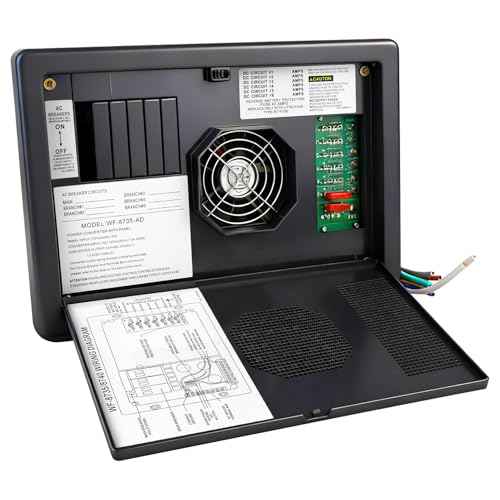
Rated at 30 to 35 amps, the WF-8735-AD converter runs a smart chip that auto-detects lead-acid or LiFePO4 batteries and adjusts charging accordingly. Three-stage charging cycles through floating, absorbing, and high-capacity modes to protect battery health. It carries one 30-amp main circuit, six DC circuits, and five AC circuits, and drops in as a replacement for the WF-8735-P. Owners report installation takes roughly fifteen minutes when you photograph the old wiring first. A five-year warranty backs it. Its limitation: at 30 amps it fits smaller rigs, so larger banks with heavy loads will want a higher-amp unit.
TypeAC to DC Converter
Output30 to 35A
Charging3-stage smart
Battery DetectLead-acid and LiFePO4
Pros
- Auto-detects lead-acid or lithium
- Integrated DC and AC circuit distribution
- Quick fifteen-minute drop-in swap
Cons
- 30 amp output limits larger rigs
- Converts only, no 120V AC output
Check price on Amazon ›
This deck-mount converter delivers 55 amps of clean DC and serves as a replacement part for RV trailer 9800-series systems. Swapping just the deck module, rather than the whole unit, keeps the job simple and less involved. It provides clean power even without battery filtering and includes a lithium-ion switch for battery chemistry. Automatic three-stage charging with three voltage output modes helps maintain battery life. The cooling fan runs only when needed, and current limiting shuts down on overload or short circuit. Its limitation: as a deck-mount charger it must match your existing 9800-series housing, so verify compatibility before ordering.
TypeDeck-Mount Converter
Output55A DC
Charging3-stage automatic
BatteryLithium-ion switch
Pros
- Deck-mount swap keeps install simple
- Lithium switch and three-stage charging
- Quiet fan runs only when needed
Cons
- Must match 9800-series housing
- Charges only, no AC household output
Check price on Amazon ›
RecPro's 35A converter uses four-stage smart charging, cycling through Fast, Standard, Trickle, and Equalization modes to preserve battery health. It handles lead-acid and lithium and offers three fixed output modes at 13.0V, 14.6V, and 16.5V for flexibility across RV, marine, and car audio use. A temperature-controlled fan keeps it whisper-quiet, running only under load. You can wire units in series or parallel for higher output, and the line scales from 35A up to 125A models. Its limitation: this 35 amp version fits modest banks, so heavy users should step up to a larger capacity in the same range.
TypeAC to DC Converter
Output35A
Charging4-stage smart
Output Modes13.0V, 14.6V, 16.5V
Pros
- Four-stage charging preserves battery life
- Series or parallel wiring for more output
- Capacity choices from 35A to 125A
Cons
- 35A model suits only modest banks
- Converts only, does not run AC devices
Check price on Amazon ›
What to look for
Inverter versus converter
Know which job you need before buying. An inverter takes 12V battery power and produces 120V AC for household electronics when you are off-grid. A converter does the opposite, feeding your 12V system and charging batteries while plugged into shore power. Several picks here are converters, so read each product tag closely.
Why pure sine wave matters
Pure sine wave output mirrors grid electricity, which sensitive gear like microwaves, CPAPs, and laptops needs to run safely. Modified sine wave units can cause hum, flicker, or early failure in delicate electronics. Every inverter in this list uses pure sine wave, protecting equipment and extending its service life.
Sizing wattage and surge
Match continuous wattage to the total draw of devices you run at once, then check the surge rating for startup spikes. Motors in refrigerators and window ACs pull heavy current the moment they kick on. A 2000W to 2500W inverter with double the surge headroom covers most household RV loads comfortably.
Battery chemistry and charging
Confirm your converter supports your battery type, whether lead-acid, AGM, or lithium. Multi-stage smart charging protects battery health and stretches lifespan across seasons. Units with dedicated lithium modes or adjustable voltage give you the tightest control, which matters as more RVers switch to LiFePO4 banks.
Frequently asked questions
Do I need an inverter or a converter for my RV?
It depends on the task. Use an inverter to run 120V household devices from your battery while off-grid. Use a converter to charge your 12V batteries and power 12V systems when connected to shore power. Many RVs use both.
Will a 2000W inverter run my RV air conditioner?
A 2000W inverter can start smaller window units thanks to surge headroom, but running a large rooftop AC continuously needs more capacity. Check your unit's running and startup draw first. For steady AC use, a 2500W or larger inverter is safer.
Is pure sine wave worth it over modified sine wave?
For sensitive electronics, yes. Pure sine wave matches grid power, so microwaves, CPAPs, and laptops run cleanly without hum or damage. Modified sine wave can shorten the life of delicate gear, which is why every inverter here uses pure sine wave output.
Can these converters charge lithium batteries?
Several can. The WAVLINK and RecPro units include lithium modes, and the WF-8735-AD auto-detects lead-acid or LiFePO4. Always confirm the model lists your chemistry, since charging lithium on the wrong profile can shorten battery life.
How hard is it to install a replacement converter?
For drop-in replacements like the WF-9855 and WF-8735-AD, many owners finish in fifteen minutes. Photograph the old wiring first, match the wire colors, and keep ventilation holes clear. If you are unsure, a mobile RV technician can wire it quickly.
What size battery bank do I need?
That depends on how long you run devices off-grid. Larger banks store more usable energy for inverters, while converters simply recharge whatever bank you have. Size your bank to your daily draw, then match the inverter and converter amperage accordingly.
Do these inverters come with battery cables?
Some do. The LANDERPOW ships with thickened 2AWG cables, and the ATS unit includes battery cables in the box. Others may require you to supply your own. Always confirm cable gauge is rated for the inverter's full current.
Why does my converter fan run intermittently?
Most of these units use temperature-controlled fans that spin up only when the unit heats under load. Quiet operation between cycles is normal and expected. Keep the ventilation holes unblocked so the fan can cool the unit effectively during heavy charging.
The verdict
LANDERPOW 2000W Pure Sine Wave Inverter, 1...
9.2/10
For running household devices off battery, the LANDERPOW 2000W is our top pick, pairing clean pure sine wave output with a handy wired LED remote. Choose the 2500W ATS unit if you want a permanent, hardwired install that switches automatically between shore and battery power. Among converters, the WAVLINK offers the most charging flexibility, while the RecPro suits owners who value four-stage charging and scalable output. Match the unit to the job, and confirm your battery chemistry first.
Check price on Amazon ›
Our top pick, secure checkout via Amazon
Note: Availability and specifications change often. Always confirm the current details on Amazon before buying.