Tools & DIY 7 Water Pressure Gauges for Accurate Readings
P
By the Pickpedia Team
·7 picks compared
·Last verified September 2026
Affiliate disclosure: As an Amazon Associate, Pickpedia earns from qualifying purchases. Links on this page are paid links, and we may earn a commission at no extra cost to you. This never affects our picks or scores.
Quick answer
For most homes, pick a gauge with a standard 3/4 inch hose thread and a clear 0 to 200 PSI dial. Add a red peak pointer if you want to catch pressure spikes, glycerin filling if vibration is present, and quick-connect fittings for RO systems.
7 Water Pressure Gauges for Accurate Readings at a glance
Why you can trust this guide
We compared these picks using verified manufacturer specifications, available manuals and documentation, current retailer listings, and patterns in owner feedback, alongside editorial research. We focus on measurable differences such as performance, capacity, usability, and build quality. Pickpedia does not present editorial research as laboratory testing, and we do not claim hands-on testing unless it was actually performed.
How we chose: We compared seven water pressure gauges across dial size, thread fitting, pressure range, peak memory, and build materials.
A reliable pressure gauge turns a guessing game into a clear reading. Whether you are checking household supply, tuning an irrigation line, or protecting a reverse osmosis system, the right dial tells you instantly if pressure sits in a safe window.
We looked at how each gauge connects, how wide its scale runs, and what its case and internals are made from. Fittings, peak-hold pointers, and vibration damping separate a quick spot check from a tool you can trust over years of use.
Our top picks
Watflow pairs a 304 stainless steel case with brass internals and glycerin filling, a combination that keeps the needle steady when pumps or hoses vibrate. The sealed case stops water from seeping in behind the lens, so readings stay clear over time. A 3/4 inch female hose thread screws straight onto a bibb, and the double scale reads 0 to 200 PSI alongside kPa. Rated accuracy sits around plus or minus 3 percent. One limitation: the compact 2 inch dial is smaller than some rivals, so those with weaker eyesight may prefer a larger face for glancing at readings from a distance.
Dial size2 inch
Thread3/4 inch female hose
Range0 to 200 PSI, double scale
Case304 stainless, glycerin filled
Pros
- Glycerin filling steadies the needle
- Sealed stainless case resists water intrusion
- Screws directly onto a hose bibb
Cons
- Small 2 inch dial is harder to read at a glance
- No peak-hold pointer
Check price on Amazon ›
DIGITEN targets reverse osmosis owners who need to watch post-filter pressure closely. Its 1/4 inch quick-connect fitting snaps into RO tubing without wrenches, and the stainless housing holds up to damp under-sink conditions. The scale spans 0 to 1.6 MPa or 0 to 220 PSI on a readable 2 inch face, which covers typical household filtration ranges with room to spare. According to the maker, monitoring this pressure is vital to keeping an RO system working as intended. The tradeoff is focus: the PE quick-connect body suits tubing systems, so anyone wanting to thread it onto a garden spigot will need a separate adapter this kit does not include.
Dial size2 inch
Fitting1/4 inch quick connect
Range0 to 1.6 MPa / 0 to 220 PSI
BodyStainless with PE connector
Pros
- Snaps into RO tubing tool-free
- Wide 0 to 220 PSI scale
- Stainless face suits damp cabinets
Cons
- Quick-connect body needs an adapter for hose bibbs
- PE connector feels less rugged than brass
Check price on Amazon ›
Express Water ships this gauge with a T-stem adapter and three locking clips, so it drops into a 1/4 inch quick-connect filtration setup in minutes. The food-grade body is lead free and BPA free, a point that matters when the water flowing past it heads to a drinking tap. Beyond RO units, owners report using it on coffee machines, ice makers, refrigerator kits, and water purifiers thanks to its universal sizing. It keeps pressure inside the window a filtration system needs to run efficiently. The main limitation is scope: it is built around quick-connect filtration plumbing, so it is not the pick for threading onto an outdoor spigot for a whole-house reading.
Fitting1/4 inch quick connect
IncludedT-stem adapter, 3 clips
MaterialFood-grade, lead and BPA free
UseRO, coffee, ice maker, fridge
Pros
- Comes with T-stem adapter and locking clips
- Lead free and BPA free body
- Fits many household filtration devices
Cons
- Focused on quick-connect plumbing only
- No red peak pointer for spikes
Check price on Amazon ›
YSIL leans on a larger 2-1/2 inch face, which makes the 0 to 100 PSI scale easy to read even in poor light. An iron shell surrounds brass wetted parts, a mix that resists corrosion where water meets metal while keeping the case rugged. The 3/4 inch brass internal thread twists onto faucets and hoses without fuss, and owners report a long service life across drip irrigation, RV tanks, spigots, and washing machine outlets. Accuracy runs around plus or minus 3 percent. Its clear limitation is range: the 100 PSI ceiling is fine for most homes but too low if you expect to measure a high-pressure line or a boosted supply that can climb past that mark.
Dial size2-1/2 inch
Thread3/4 inch brass internal
Range0 to 100 PSI
BuildIron shell, brass wetted parts
Pros
- Large dial reads easily in low light
- Brass wetted parts resist corrosion
- Threads onto faucets and hoses simply
Cons
- 100 PSI ceiling limits high-pressure use
- No peak-hold indicator
Check price on Amazon ›
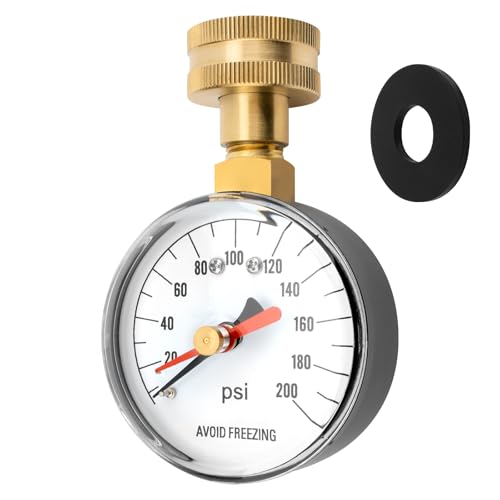
This gauge earns its place with a red max pointer that holds at the highest reading it registers, letting you capture peak events while you are away from the dial. A copper alloy Bourdon sensing element drives readings across 0 to 200 PSI, wide enough to flag both weak supply and dangerous highs that stress appliances. A standard 3/4 inch hose thread screws onto a spigot, washing machine outlet, or water heater drain valve for an instant check. Reviewers note it works well for diagnosing whether a regulator is needed. One limitation: the peak pointer must be reset manually between tests, so a forgotten reset can leave you reading an old spike instead of the current one.
Dial size2 inch class
Thread3/4 inch garden hose
Range0 to 200 PSI
SensorCopper alloy Bourdon tube
Pros
- Red pointer holds peak pressure
- Copper alloy element for steady readings
- Fits spigots and appliance drain valves
Cons
- Peak pointer needs manual reset
- Compact face is smaller than 2.5 inch rivals
Check price on Amazon ›
This kit bundles a glycerin-filled 0 to 200 PSI gauge with five adapters, so one tool covers a garden hose quick connect, 3/8 inch and 1/4 inch tube fittings, a 1/2 inch NPT connection, and a stop valve adapter. That range lets you jump between home plumbing, irrigation, sprinklers, and industrial or agricultural lines without buying separate meters. Glycerin filling damps needle flutter, which helps when readings come off pumps or pulsing systems. Installation means picking the right head and twisting it onto the equipment. The limitation is organization: with six pieces to track, a missing adapter can strand you mid-test, so the small parts are worth storing together in one pouch.
Range0 to 200 PSI
FillGlycerin filled
Adapters5 included plus stop valve
FittingsGHT, 3/8, 1/4, 1/2 NPT
Pros
- Five adapters cover many systems
- Glycerin damps needle flutter
- Handles home, garden, and industrial lines
Cons
- Loose adapters are easy to misplace
- No peak-hold pointer
Check price on Amazon ›
CARBO combines precision and toughness in one dial. The dual-scale face reads 0 to 200 PSI and 0 to 14 Bar with an ASME Grade A accuracy rating, and a red max pointer retains peak spikes for later review. A rust-proof plastic case, brass connector, and copper alloy internals resist corrosion, while an anti-fog lens and rubber seal keep the large 2.5 inch dial clear in wet or low-light conditions. Included Teflon tape helps seal the standard 3/4 inch thread. The maker states the Bourdon tube withstands more than ten thousand cycles. The limitation is heft: the larger 2.5 inch body is bulkier to pack than the compact 2 inch gauges if space is tight.
Dial size2-1/2 inch
Range0 to 200 PSI / 0 to 14 Bar
AccuracyASME B40.1 Grade A
ExtrasRed max pointer, Teflon tape
Pros
- Grade A accuracy with dual scale
- Anti-fog lens stays clear when wet
- Bourdon tube rated for heavy cycling
Cons
- Larger body is bulkier to store
- Plastic case looks less premium than metal
Check price on Amazon ›
What to look for
Match the thread to your fitting
Most home spigots, hoses, and washing machine outlets use a 3/4 inch garden hose thread, so a gauge with that connection screws on directly. Reverse osmosis and filtration systems instead use 1/4 inch quick-connect tubing. Confirm which one you have before buying, because the wrong fitting means chasing adapters later.
Pick a range that fits your system
A 0 to 200 PSI scale suits most households and leaves headroom for spikes. If you only test low-pressure faucet lines, a 0 to 100 PSI gauge reads finer detail. Choose a ceiling comfortably above your expected pressure so the needle sits mid-dial where it is easiest to read.
Decide if you need peak memory or glycerin
A red max pointer holds the highest pressure registered, which is essential for catching spikes that stress appliances while you are not watching. Glycerin filling damps needle flutter on pumps and pulsing lines. Neither is mandatory, but each solves a specific problem worth naming before you choose.
Weigh dial size against portability
A larger 2.5 inch face is easier to read in dim or wet conditions and suits fixed testing. Compact 2 inch gauges pack smaller for an RV or toolbox. Think about where you will use it most, since readability and portability pull in opposite directions.
Frequently asked questions
How do I know what water pressure my home should have
Most residential systems run comfortably in a moderate range, and readings that sit too low weaken flow while readings too high stress pipes and appliances. Screw a gauge onto an outdoor spigot, open the valve fully, and read the dial to see where your supply stands.
What does the red pointer on some gauges do
The red max pointer moves with the needle and stays parked at the highest pressure the gauge records. It lets you capture peak spikes that happen when you are not watching, which helps decide whether a pressure regulator is needed. Reset it manually before each new test.
Why choose a glycerin-filled gauge
Glycerin filling cushions the internal movement, so the needle stays steady instead of flickering when pressure pulses from a pump or vibrating line. Steadier readings are easier to trust. The sealed fill also helps keep moisture and debris out of the mechanism over time.
Can one gauge test both a garden hose and an RO system
Only if it has the right fittings. Hose bibbs use a 3/4 inch thread while RO systems use 1/4 inch quick connect. A kit with multiple adapters, like the five-adapter set here, bridges both, but a single-fitting gauge covers just one type.
How accurate are these gauges
Several list accuracy around plus or minus 3 percent, and the CARBO model cites an ASME Grade A rating for tighter precision. For diagnosing household pressure problems, that level is more than enough to tell whether your supply sits in a safe window or needs adjustment.
Do I need Teflon tape to install one
Threaded connections seal better with a wrap of Teflon tape, which prevents seepage at the joint. The CARBO gauge includes tape in the box. For quick-connect fittings on filtration systems, tape is not needed since the connector seals with an O-ring instead.
What is the difference between a 2 inch and 2.5 inch dial
The larger 2.5 inch face spreads its markings wider, making the needle easier to read in low light or wet conditions. A 2 inch dial packs smaller for storage or travel. Both measure pressure the same way, so the choice comes down to readability versus portability.
Will these gauges work outdoors in wet weather
Many are built for it. Look for stainless or rust-proof cases, brass or copper wetted parts, and sealed lenses. The CARBO model adds an anti-fog lens and rubber seal for wet use, while stainless and glycerin-filled options resist corrosion around damp spigots and irrigation lines.
The verdict
Watflow 2" Glycerin Filled Stainless Steel...
9.2/10
For a do-everything pick, the CARBO Instruments gauge blends Grade A accuracy, a peak pointer, and an easy-read 2.5 inch dial. The Watflow stainless model is our steady all-rounder for vibrating garden lines. RO and filtration owners should reach for the DIGITEN or Express Water quick-connect units, while anyone testing many systems will get the most mileage from the five-adapter glycerin kit. Match thread and range to your setup first.
Check price on Amazon ›
Our top pick, secure checkout via Amazon
Note: Availability and specifications change often. Always confirm the current details on Amazon before buying.