Tools & DIY 6 Welding Fume Extractors for Cleaner Breathing
P
By the Pickpedia Team
·6 picks compared
·Last verified September 2026
Affiliate disclosure: As an Amazon Associate, Pickpedia earns from qualifying purchases. Links on this page are paid links, and we may earn a commission at no extra cost to you. This never affects our picks or scores.
Quick answer
For steady welding at a bench, pick an extractor whose airflow and filtration match your fume load. Light soldering suits compact desktop units with 3-stage filters, while heavier MIG, TIG, or stick work needs mobile arms, HEPA media, and stronger suction. Match hose reach to your station.
6 Welding Fume Extractors for Cleaner Breathing at a glance
Why you can trust this guide
We compared these picks using verified manufacturer specifications, available manuals and documentation, current retailer listings, and patterns in owner feedback, alongside editorial research. We focus on measurable differences such as performance, capacity, usability, and build quality. Pickpedia does not present editorial research as laboratory testing, and we do not claim hands-on testing unless it was actually performed.
How we chose: We compared six welding and soldering fume extractors, weighing airflow, filtration stages, noise, mobility, and how close the hood must sit to work.
Welding and soldering release fine particles and vapors that hang in your breathing zone long after the arc stops. A capable extractor pulls that plume away before it drifts, then filters it through pre-filters, HEPA media, and activated carbon. Owners consistently link cleaner air to choosing enough airflow for the job.
Choices here range from small desktop soldering absorbers to mobile industrial arms built for a busy shop. Reviewers note that hose reach, filter replacement habits, and noise matter as much as raw suction. Below, each pick is framed around who it genuinely fits, based on published specifications.
Our top picks
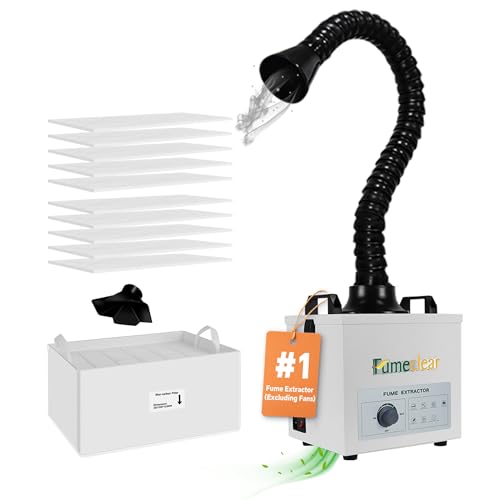
Built around light bench work, the FC-100A runs a 100W motor and a 3-layer filter that the maker rates at 99.97 percent capture of particles below 0.3 microns. Its main carbon element uses high-iodine activated media rated for roughly 3000 hours before replacement, and ten pre-filters catch coarse dust. Suction reaches up to 200 cubic meters per hour, enough to grab fine debris near the hood. CE and FCC certification are listed. One clear limitation, this unit is not meant for large laser engravers, where FumeClear points you toward heavier models.
Rated power100W
AirflowUp to 200 m3/h
Filtration3 layers plus pre-filters
Carbon lifeAbout 3000 hours
Pros
- Compact footprint suits a soldering bench
- High-iodine carbon rated for long service
- Ten pre-filters shield the main filter
Cons
- Not intended for large laser engravers
- Suction best only close to the hood
Check price on Amazon ›
Miller Electric brings shop credibility to this extractor, and its filter is sized for real welding output at 16 square feet of media. Rated flow sits at 132 CFM, with a high-performing filter designed to capture the submicron particles that welding throws off. An 8-foot hose gives room to position the intake around your work without moving the whole unit. Documentation stays sparse compared with newer arrivals, so buyers relying on detailed spec sheets or multi-stage carbon breakdowns will find less published here. For welders who value a recognized brand, it remains a straightforward choice.
Airflow132 CFM
Filter media16 square feet
Hose length8 feet
CapturesSubmicron welding particles
Pros
- Recognized welding brand behind it
- Generous 16 square feet of filter media
- Long 8-foot hose for positioning
Cons
- Sparse published specification detail
- No stated multi-stage carbon breakdown
Check price on Amazon ›
Designed to roll wherever the work is, this mobile collector rides on four lockable casters and carries a 6.56-foot articulated suction arm. Three filtration stages, pre-filter, HEPA, and activated carbon, reach 99 percent efficiency down to 0.3 microns. An anti-static aluminum shell targets spark and static risk in flammable welding areas, a genuinely useful touch for busy bays. Filter covers and the arm detach without special tools, so upkeep stays simple. It spans MIG, TIG, and stick welding plus laser and 3D printing. Being a larger mobile chassis, it needs more floor room than any desktop absorber, so tight benches may struggle.
Filtration3-stage to 0.3 micron
Suction arm6.56 ft articulated
Chassis4 lockable casters
ShellAnti-static aluminum
Pros
- Rolls freely between weld stations
- Anti-static shell aids spark safety
- Tool-free filter and arm servicing
Cons
- Larger footprint than desktop units
- Heavier to relocate up stairs
Check price on Amazon ›
Zericuf pairs strong airflow with unusually low noise, a combination many desktop units miss. A 180W brushless copper motor drives 320 cubic meters per hour, yet an acoustic and damping foam chamber keeps sound under 58 decibels. Three stages handle the rest, double-thickness pre-filters, a true H13 HEPA rated at 99.997 percent on 0.3 micron particles, and high-iodine carbon at 800 to 900 milligrams per gram. A clog buzzer, stepless suction knob, swivel casters with brakes, and a 360 degree arm round it out, backed by a 5-year warranty. As a fuller industrial desktop unit, it takes up more bench space than a mini gooseneck absorber.
Airflow320 m3/h
Motor180W brushless copper
NoiseUnder 58 dB
HEPAH13 rated 99.997%
Pros
- Strong airflow with low measured noise
- True H13 HEPA and high-iodine carbon
- Clog buzzer plus stepless suction control
Cons
- Larger than compact gooseneck absorbers
- Replacement filters add ongoing upkeep
Check price on Amazon ›
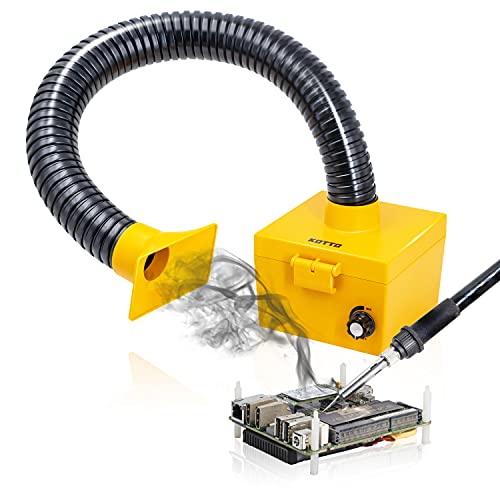
KOTTO keeps things light and grab-and-go, running from a plug and staying usable while charging. A 24-inch flexible tube bends the hood toward your iron, and the adjustable 6000 RPM fan clears fumes from about 5 to 6 inches away. Rated output sits at 40W and 52 CFM with a 55 decibel noise level and a stated 50,000 hour fan life. Filters swap easily and a spare comes included, which owners appreciate for quick turnaround. Suction is modest next to industrial arms, so this fits soldering and light hobby work rather than sustained heavy welding plumes.
Airflow52 CFM
Fan speed6000 RPM adjustable
Tube24-inch flexible
Noise55 dB
Pros
- Light and easy to reposition
- Usable while plugged in or charging
- Spare filter included in the box
Cons
- Modest suction for heavy welding
- Effective only a few inches away
Check price on Amazon ›
KQZ shrinks solid filtration into a mini metal body that tucks onto a crowded bench. A centrifugal motor moves 168 cubic meters per hour, and the dual-layer design adds a 9mm thicker pre-filter ahead of an H13 HEPA cartridge with coal-based activated carbon. That media is rated to trap 99.99 percent of fume, dust, and 0.3 micron particles while adsorbing heavy metals and vapors. Wide 110 to 220 volt input and a 360 degree gooseneck make setup flexible for soldering, 3D printing, or light welding. Airflow trails the larger arms here, so it suits detail work more than a full welding bay.
Airflow168 m3/h
FilterH13 HEPA with carbon
Pre-filter9mm thickened
Hose360 gooseneck
Pros
- Compact metal body saves bench room
- Thick pre-filter extends main filter life
- Wide voltage input for flexible setup
Cons
- Lower airflow than mobile arms
- Better for detail than heavy welding
Check price on Amazon ›
What to look for
Match airflow to your fume load
Light soldering clears with modest airflow, while active welding throws a denser plume that needs stronger suction. Compare CFM or cubic meters per hour across listings, then leave headroom so the unit is not maxed out on every job.
Understand the filter stages
Most capable units layer a pre-filter, a HEPA element, and activated carbon. Pre-filters catch coarse dust and protect the sensitive HEPA behind them, while carbon adsorbs odors and vapors. True H13 HEPA captures the finest particles welding produces.
Weigh hose reach and mobility
A longer hose or articulated arm lets you position the intake right over the arc without dragging the whole unit. Mobile casters help shops that move between stations, while a short gooseneck suits a fixed soldering bench.
Plan for noise and upkeep
Noise ratings vary widely, and a quiet chamber makes long sessions bearable. Factor in how often pre-filters and main filters need swapping, since easy replacement and included spares keep a unit running with little downtime.
Frequently asked questions
Do I really need a fume extractor for soldering?
Solder flux and welding both release fine particles and vapors that linger in your breathing zone. Reviewers and safety guidance point to local extraction as the most direct way to keep that plume out of your lungs during regular work.
What does a 3-stage filter actually do?
Each stage handles a different threat. Pre-filters trap coarse dust, HEPA media captures submicron particles, and activated carbon adsorbs odors and chemical vapors. Together they clean the air far better than a single-layer filter can manage.
How close should the hood sit to my work?
Suction falls off quickly with distance, so most desktop absorbers work best within several inches of the source. Position the hood just above the fume plume, and use a flexible arm to keep it there as you move.
What is H13 HEPA and why does it matter?
H13 is a high grade of HEPA media rated to capture around 99.99 percent of 0.3 micron particles. Welding and soldering emit particles in that fine range, so H13 filtration targets exactly what you most want removed.
Can a small unit handle real welding?
Compact absorbers shine at soldering, 3D printing, and light welding, but heavy MIG, TIG, or stick output produces more fume than they can fully capture. For sustained welding, a mobile arm with higher airflow is the safer match.
How often do filters need replacing?
It depends on use and how well pre-filters shield the main element. Thicker pre-filters and clog alerts help you time swaps, and some carbon filters are rated for thousands of hours before they need attention.
Does noise really matter?
During long sessions it does. Units with soundproof chambers stay well below the level of louder fans, which reduces fatigue. Check the stated decibel rating and remember that stronger airflow does not always mean louder operation.
What features help in a welding shop?
Look for mobility, anti-static or spark-safe construction, and a long articulated arm. Lockable casters let you serve several stations, while tool-free filter access keeps maintenance quick in a busy bay.
The verdict
FumeClear FC-100A Fume Extractor Low-Noise...
8.9/10
For most heavy soldering and laser stations, the Zericuf leads with strong airflow, true H13 HEPA, and genuinely low noise. Busy shops moving between weld bays should lean toward the CE Certified mobile arm, while the Miller Electric suits welders who want a trusted name. Bench hobbyists are well served by the FumeClear FC-100A or the compact KQZ B1, and the light KOTTO fits makers who carry their setup room to room.
Check price on Amazon ›
Our top pick, secure checkout via Amazon
Note: Availability and specifications change often. Always confirm the current details on Amazon before buying.