Home ›
Tools & DIY › Why a Batteryless Soil pH Meter Measures Salt
Tools & DIY
Why a Batteryless Soil pH Meter Measures Salt
PBy the Pickpedia Team·3 picks compared·Last verified October 2026
Affiliate disclosure: As an Amazon Associate, Pickpedia earns from qualifying purchases. Links on this page are paid links, and we may earn a commission at no extra cost to you. This never affects our picks or scores.
This page contains affiliate links. If you buy through one we may earn a
commission, at no cost to you.
The question skips a step, and the skipped step is the whole problem. Before you can lower a soil
pH you have to know what it is, and the instrument almost everybody reaches for cannot tell you. Not
roughly. Not as a trend. It is not measuring pH at all, and the clue is printed on
it as a selling point: no batteries required.
That sounds like an accusation. It is arithmetic, and it comes out of two numbers that have been
known for a century.
What a pH measurement is, and why it cannot be passive
Measuring pH is a potentiometric measurement. A thin glass membrane develops an
electrical potential across itself that depends on the hydrogen ion activity on each side, and that
potential follows the Nernst relation: 2.303 times the gas constant times absolute temperature,
divided by the Faraday constant. At 25 degrees Celsius that is 59.17 millivolts per pH
unit.
Soil sits in a narrow band. From pH 5 to pH 8 covers nearly everything a gardener will meet, and
three pH units at 59.17 millivolts each is 177.5 millivolts in total. That is the
entire signal, end to end.
Two things are needed to read it, and both are the obstacle.
First, a reference half-cell. A single electrode has no voltage; voltage is a
difference. So a pH meter carries a second electrode of known, fixed potential to measure against,
usually a silver chloride cell in a salt bridge. Two bare metal prongs pushed into soil are not that.
They are two unknowns.
Second, an amplifier. A glass membrane thin enough to respond to hydrogen ions
has an internal resistance somewhere between ten million and a billion ohms. To read a voltage across
a source that stiff without collapsing it, the meter needs an input impedance a hundred to a thousand
times higher again, which is a billion to a trillion ohms. There is no passive component that
does that. It is an active circuit, and an active circuit needs a power source.
So a meter whose headline feature is that it has no battery has told you, on the front of the
packet, that it contains no pH measurement.
A pH reading needs a reference
half-cell and an amplifier with a billion ohms of input impedance, so a meter whose selling point is
that it needs no battery is a galvanic cell reading conductivity. That swings by a factor of 100 with
moisture while all of pH 5 to 8 could move its driving voltage by 16.1 percent.
What the needle is actually responding to
A
three in one houseplant health meter
for moisture, light and pH publishes a single elongated probe, a three position toggle, no
batteries to buy or replace, indoor or outdoor use, and a note that it performs best in loose aerated
potting mixes. It also publishes, in the same paragraph as the three readings, the sentence that
settles the whole question: "A dual-sensor design drives the readings."
Two sensors. Three dials. One of the three is reading a sensor that belongs to another one.
Here is the mechanism. Two dissimilar metals in a moist electrolyte are a galvanic cell. The
device is the battery, which is precisely why it does not need one. Take a copper and zinc
pair as an illustration: copper's standard potential is plus 0.3419 volts and zinc's is minus 0.7618,
so the cell delivers 1.104 volts. That is the needle's driving voltage, and it is a
property of the metals, not of the soil.
What the soil contributes is resistance. The current through the galvanometer is
1.104 volts divided by the soil resistance plus the meter's own, and soil resistivity runs from
roughly 10 ohm metres when wet and salty to around 1,000 when dry and sandy. That is a factor
of 100, and it is the full sweep of the needle.
Now set the two sensitivities against each other. Moisture and dissolved salt move the reading
across two orders of magnitude. The entire pH range, if a pH sensitive junction existed in there at
all, could move the driving voltage by 177.5 millivolts out of 1,104, which is 16.1
percent. Divide: the instrument is roughly 620 times more responsive to how wet and
salty the soil is than to the quantity a glass electrode would be reading.
Which is exactly why the same two prongs are also sold as the moisture meter. They are not two
instruments sharing a body. The pH dial is the moisture measurement on a different
scale.
And the light reading, to be fair to the product, is the one that legitimately works with no
battery, because a photovoltaic cell generates its own current from the light falling on it. So the
"dual sensor design" is a galvanic prong pair and a photocell, both honest, and the third scale is the
first one relabelled.
The record's own caveats are the mechanism confessing
That listing is more candid than most, and once you know what is going on, its drawbacks read like
a description of a conductivity meter.
It says readings "show trends, not exact lab values", and that "basic probe meters give useful
trends rather than lab-grade numbers". On moisture, that is simply true and useful. On pH, the trend
it shows is a trend in wetness.
It says "Dense or compacted mixes can throw readings off", and that the probe "performs best in
the loose, aerated soils typical of potted houseplants". That is the conductivity mechanism
stating itself. Compaction changes how much soil is pressed against the metal, which changes
the contact resistance, which moves the needle. A glass electrode does not care how tightly anything
is packed around it, because it is reading a potential and not passing a current.
What the probe is genuinely good for is the thing the question underneath this one is usually
really asking: whether to water yet. On that it is a real instrument, and far better than a finger in
the top inch, because it reads at the depth the roots are at. That is the subject of
how to know when to water your
houseplants, and the full record is in our
review of the three in
one houseplant meter.
The trap: feeding the plant moves the pH needle
This is where the arithmetic becomes practical rather than pedantic, and it bites exactly the
person asking how to change a pH.
One teaspoon is 4.93 millilitres and two cups is 473.2, so that is a 1 in 96
dilution, 1.042 percent by volume. And a liquid fertiliser concentrate is a
salt solution: nitrates, phosphates and potassium salts, all dissolved, all
conductive.
So every feeding raises the medium's electrical conductivity. Which raises the current through the
prong meter. Which moves the pH needle, with no change in acidity required at all.
Feed the plant and re-test, and the dial will have shifted, and you will conclude that the feed
changed the pH.
How far it shifts cannot be computed, and that is worth being explicit about: the record publishes
an NPK ratio and a dilution, and no concentration. A 3-1-2 is three parts to
one part to two parts of something, and the listing does not say three percent of what. The direction
is certain and the magnitude is not. Details in our
review of the 3-1-2 liquid
fertilizer.
The instrument in this catalogue that honestly measures what the prongs measure
There is one, and it is in a completely different aisle. A
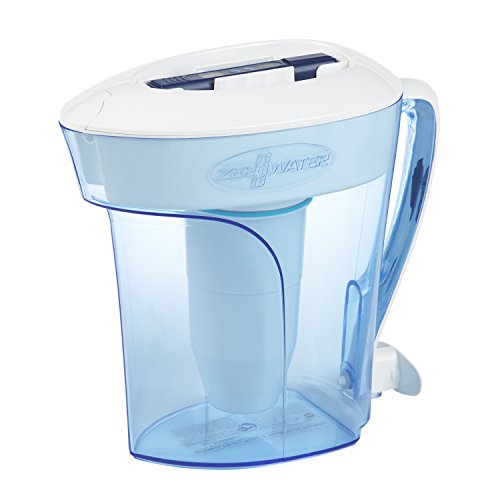
ZeroWater 10 cup pitcher with a five
stage ion exchange filter publishes a built in TDS meter in the lid, IAPMO
certification for lead, chromium, mercury and PFOA and PFOS, BPA free plastic, and the honest
admission in its own drawbacks that the meter "needs a manual check" and "will not alert you
automatically when the filter is spent".
TDS is total dissolved solids, and it is measured as electrical conductivity.
Which is precisely the quantity the soil prongs respond to. So that pitcher lid contains a properly
scaled version of the measurement the garden probe is actually making, and it is sold for what it is.
And now the orthogonality, because this is the cleanest way to show that pH and conductivity are
nearly unrelated quantities. At pH 4, the hydrogen ion concentration is a ten thousandth of a mole per
litre, which at 1.008 grams a mole is 0.1008 milligrams a litre. At pH 7 it is
0.0001. The difference across three whole pH units is 0.1007 milligrams a litre.
Against a typical tap reading of 150 to 400 milligrams a litre, that is between
one part in 4,000 and one part in 1,500. Moving the acidity by a factor of a
thousand changes a conductivity reading by about a twentieth of one percent. The two
quantities are close to independent, which is why a conductivity instrument cannot be rescaled into a
pH one by any amount of cleverness, and why the hydrogen ion is not what the needle is counting.
The filter record's other point is also conductivity doing its job properly: high TDS water
exhausts an ion exchange bed faster, because the bed is capturing ions and there are more of them.
More in our
review of the ZeroWater
pitcher and the category in
best water filter pitchers.
What this leaves the question with
Our page on
why an aquarium's pH falls while you
change the water works the chemistry side of this problem properly: pH is the symptom and the
buffer capacity is the thing that moves, and adding or removing acid without accounting for the
carbonate reserve produces exactly the confusing result the aquarium question describes. A raised bed
has the same structure, with the carbonate reserve living in the mineral fraction and the organic
matter instead of in the water.
What the arithmetic here adds is narrower and more useful: the prong meter is not the
instrument for the job, and nothing you do to it makes it one. A measurement with a reference
half-cell and an amplifier is a different device; a dilute soil slurry read with pH paper or test
drops at least has a reference reaction and no conductivity term at all; and either of those is a
starting point for the question as asked.
What the prong meter is genuinely for is moisture, where it is a good tool, and relative light,
where it is a rough one. Those are two real measurements and they are both on the same instrument.
Soil preparation, which is what actually shifts a bed's buffer, is covered in
preparing
garden soil, and the water-holding side of the same physics is in
why raising a drain hole five
centimetres halves a pot's air.
The honest limit, and three things not computed
What is exact: the 59.17 millivolts per pH unit from the Nernst relation at 25
degrees, the 177.5 millivolts across three pH units, the hydrogen ion mass arithmetic giving 0.1008
and 0.0001 milligrams a litre, and the 1 in 96 dilution from two published volumes.
What is representative rather than published, and the first item matters most. The
copper and zinc couple at 1.104 volts is an illustration: the meter publishes
no probe metal at all, so that is a plausible galvanic pair and not its pair. A different
couple shifts the baseline and therefore the 16.1 percent, but not the structure of the argument,
because any two dissimilar metals give a baseline of the same order and the resistivity term still
spans a factor of 100. The 10 to 1,000 ohm metre soil resistivity range, the
150 to 400 milligrams a litre tap TDS, and the ten million to a billion
ohms of glass electrode resistance are all standard values.
Three things deliberately not computed. The actual needle deflection, because the
record publishes no internal resistance, no galvanometer full scale current and no probe spacing or
surface area, and all three are needed; the shape of the argument survives their absence and a number
would not. The added conductivity from one feeding, because the fertiliser record
gives a ratio and a dilution and no concentration, so the magnitude is genuinely unavailable rather
than merely tedious. And whether any particular bed needs its pH changed, which is an
agronomic question about a specific soil and a specific crop, and is not something a page about
instruments should answer.
Three numbers to carry. A pH measurement is 59.17 millivolts per unit read across
a source of a billion ohms, so it requires a reference electrode and an amplifier and therefore a
battery. A batteryless prong meter is a galvanic cell whose reading swings by a factor of
100 with moisture while all of pH 5 to 8 could move it by 16 percent, a sensitivity ratio of
about 620 to 1. And three whole pH units change a conductivity reading by one part in a
couple of thousand, which is why one instrument cannot be the other.
Why a Batteryless Soil pH Meter Measures Salt at a glance
ZeroWater 10-Cup Pitcher Water Filter Removes PFOA/PFAS
Households wanting to remove virtually all dissolved solids and specific contaminants like lead and PFOA/PFOS.
Removes virtually all dissolved solids IAPMO certified to reduce PFOA/PFOS, lead, chromium, mercury Includes TDS meter to monitor filter performance BPA-free plastic construction Compatible with ZeroWater and Culligan ZeroWater systems Can save up to 110 single-use plastic bottles per filter
TDS meter requires manual testing Filter may need frequent replacement on high-TDS water Ready-pour design may be slower than some pitchers No automatic filter change indicator
Why you can trust this guide
We compared these picks using verified manufacturer specifications, current retailer listings, and patterns in owner feedback, alongside editorial research. We focus on measurable differences such as performance, capacity, usability, and build quality. Pickpedia does not present editorial research as laboratory testing, and we do not claim hands-on testing unless it was actually performed.
Best for beginners wanting to time watering and feeding
8.2/ 10 Pickpedia editorial score
This 3-in-1 meter reads soil moisture, sunlight, and pH for houseplants using a single probe and a simple toggle. A dual-sensor design tells you when to water and when to fertilize, helping prevent root rot and leaf burn. It needs no batteries, works indoors or outdoors, and suits fiddle leaf figs, monsteras, pothos, and other potted plants.
Best for dedicated fiddle leaf fig and ficus feeding
8.4/ 10 Pickpedia editorial score
This is an 8 oz liquid plant food formulated for fiddle leaf figs and ficus, with a 3-1-2 NPK ratio. It suits owners wanting a dedicated feed rather than a generic fertilizer. The maker states it uses three forms of nitrogen for steady nutrition. You mix one teaspoon per two cups of water, and a bottle lasts roughly six months to a year.
Volume8 oz
NPK ratio3-1-2
FormLiquid concentrate
Mix rate1 tsp per 2 cups water
Coverage6 months to a year
OriginMade in USA
Pros
Formula tailored to fiddle leaf figs and ficus
Three forms of nitrogen for steady feeding
Easy one-teaspoon-per-two-cups mixing
One bottle lasts six months to a year
Gentle enough for every watering session
Included webinar and e-book add guidance
Cons
Certification and lab claims are maker-stated
Feeding alone will not fix light or watering issues
Best for Households wanting to remove virtually all dissolved solids and specific contaminants like lead and PFOA/PFOS.
8.8/ 10 Pickpedia editorial score
The ZeroWater 10-Cup Pitcher uses a 5-stage ion exchange filter to remove virtually all dissolved solids, including lead, chromium, mercury, and PFOA/PFOS, as certified by IAPMO. It comes with a TDS meter so you can test the water before and after filtration, and it's made from BPA-free plastic. The pitcher is compatible with ZeroWater and Culligan ZeroWater systems and filters. While it offers excellent filtration, the filter may need frequent replacement depending on your source water, and the TDS meter is a helpful but manual check.
Check Your TdsThe 10 Cup 5-Stage Ready-Pour Water Filter Pitcher D
Advanced FiltrationOur 5-Stage Ion Exchange Filter removes virtually al
Iapmo Certified & BPA-FreeOur 5-Stage filter is IAPMO Certified to reduce PFOA
Your New Water Filter SystYour purchase includes a 10 Cup water filter pitcher
Less Plastic, More HydratiYou can save up to 110 single-use plastic bottles pe
Pros
Removes virtually all dissolved solids IAPMO certified to reduce PFOA/PFOS, lead, chromium, mercury Includes TDS meter to monitor filter performance BPA-free plastic construction Compatible with ZeroWater and Culligan ZeroWater systems Can save up to 110 single-use plastic bottles per filter
Cons
TDS meter requires manual testing Filter may need frequent replacement on high-TDS water Ready-pour design may be slower than some pitchers No automatic filter change indicator