Home ›
Tools & DIY › Why a Twist Drill Cannot Enlarge a Hole
Tools & DIY
Why a Twist Drill Cannot Enlarge a Hole
PBy the Pickpedia Team·3 picks compared·Last verified October 2026
Affiliate disclosure: As an Amazon Associate, Pickpedia earns from qualifying purchases. Links on this page are paid links, and we may earn a commission at no extra cost to you. This never affects our picks or scores.
This page contains affiliate links. If you buy through one we may earn a
commission, at no cost to you.
The short answer is that the best way to enlarge a hole with a cordless drill is to not use a
twist drill for it, and the reason is more interesting than the advice. A twist drill is not
guided by its point. It is guided by two narrow strips behind the cutting edges, and in this
particular job those strips never touch the work at all.
Once you see where a drill's guidance actually comes from, two surprises fall out of the same
piece of arithmetic: why enlarging a hole produces a lobed, oversized mess, and why the same bit
misbehaves in thin sheet for exactly the same reason.
The margins are the bearing, and they arrive late
Look at the business end of a twist drill. There is a cone, there are two cutting lips, and
behind the lips, running up the length of each flute, there is a narrow land at the full diameter of
the bit. Those lands are called margins, and they are the only part of a twist drill
that is a bearing surface. Once they are inside the hole, the bit is a shaft in a journal and it
goes where the hole goes.
The point does something different and smaller: it stops the bit skating at the instant of
contact. After that it contributes almost nothing to position, because a cone sitting in a cone it
cut itself cannot resist being pushed sideways.
Now the timing. The margins start where the lips end, which is at the top of the cone, so they
reach the surface only after the whole cone is below it. Our page on
why a drilled hole has two depths works out that
distance exactly, and this page uses its numbers rather than re-deriving them so the two agree: the
cone is half the diameter divided by the tangent of half the included angle, which is
0.300 of the diameter at the ordinary 118 degree grind and 0.207 at
135 degrees.
So the sentence worth carrying is this. A twist drill is unguided from first contact
until it is 0.300 of its own diameter deep. On a 20 millimetre bit that is 6.0 millimetres
of unguided cutting, every single time, with nothing but the operator's hands deciding where the
axis is.
A twist drill is held on axis by its
margins, and they cannot reach the work until the point is 0.300 diameters deep. Opening an 18 mm hole
to 20 leaves ten percent of each lip cutting, drops the torque to 19 percent, and amplifies the bit's
own grinding asymmetry by D over D minus d, which is ten, with nothing left to resist it.
The first consequence: thin stock never gets guided at all
Turn that round. The bit only becomes guided in material thicker than its own point depth, so the
largest diameter that gets guided at all in a sheet of thickness t is t divided by
0.300 at the ordinary grind.
In 1.5 millimetre sheet that is 5.0 millimetres. In 3 millimetres it is 10. In 6
millimetres it is 20. Go above that and the hole is finished before the margins arrive, which is
precisely the familiar experience of a large twist drill in sheet metal: it grabs, it walks, it
leaves a triangular opening, and no amount of care fixes it, because the feature that would have
fixed it is still in the air.
And this is where a published point angle turns into a real number. A
19 piece cobalt grade set of stepped
point drill bits with 135 degree split tips publishes exactly the grind this arithmetic needs. At
0.207 instead of 0.300, the largest guided diameter in any given sheet rises by
0.300 over 0.207, which is 1.449, about 45 percent. In the same 1.5 millimetre sheet
it goes from 5.0 to 7.25 millimetres. That is not marketing. It is the only
mechanical benefit of a point angle that can be computed from a listing, and it follows from one
published number.
The split grind does a second thing worth separating from the first. On an ordinary point the web
at the centre is not a cutting edge at all, because the cutting speed at the axis is exactly zero
and no rotation rate changes that; it indents rather than cuts, which is why a centre punch helps
and why that region takes a disproportionate share of the thrust. Grinding the web back so the edges
reach the axis is what the record means by "self-centers and penetrates with less pressure", and it
is true.
Two honest notes on that record. Its own drawbacks field says the listing "mixes M35 and M2 grade
references", which is a genuine contradiction between a title and a description and the record is
right to flag it, so treat the steel grade as maker stated. And its "four times sharper" claim is a
comparative with no quantity attached, which its own cons also say. Neither affects the point angle.
Full record in our
review of the 19 piece
stepped point set, and the heat side of drilling metal, which is a separate failure mode
entirely, is in
why your drill bits go blunt in metal.
The second consequence: enlarging a hole removes both of the drill's locating features at once
Here is the question as asked. A drill of diameter D opening an existing hole of diameter d
engages each lip only over the band from d over 2 out to D over 2. The rest of the lip, the inner
part, is passing over a hole. So the engaged fraction of each lip is one minus d over
D.
Open an 18 millimetre hole to 20 and that fraction is 0.10. Ten percent of each
cutting edge is doing anything at all.
The mean cutting radius moves outward at the same time, from D over 4 to D plus d over 4, which is
5.0 millimetres to 9.5, a factor of 1.90. Torque goes as the engaged length times
the mean radius, so it falls to 0.10 times 1.90, which is 19 percent of drilling
from solid, and thrust, which does not have the radius in it, falls to 10 percent.
Every one of those numbers says the job is easy, and the job is not easy. The reason is the term
nobody computes.
A production twist drill has a lip height error: one lip stands slightly proud of
the other, because they were ground separately. Call it five hundredths of a millimetre, which is
ordinary. From solid, that error is 0.5 percent of a 10 millimetre engaged lip, and the resulting
side force is trivial. Opening 18 to 20, it is 5 percent of a 1 millimetre engaged
lip.
The same grinding error is amplified by exactly D divided by D minus d, which here is a
factor of ten. And it is amplified at the one moment when both of the things that would
resist the resulting side force are absent: the chisel edge at the centre is hanging in air over the
old hole, and the margins are above the surface and, because the hole is already there, will never
arrive. A two edged tool free to move sideways in a hole it is cutting produces a lobed hole, which
is why the result is reliably oversize and out of round rather than merely rough.
So the whole difficulty of this job is in one ratio, and the fix is not technique. It is bringing
your own bearing surface.
Three tools, three different bearings, each one stated in its own record
A leading step that rides the old hole. This is what the stepped point set above
is for, and its record says so directly: "Enlarging existing holes is a stated use as well as fresh
drilling." A step small enough to enter the existing hole turns the hole you already have
into the bushing for the cut you are about to make, which restores the margin function at the one
moment a plain twist drill loses it. Its record publishes no step diameter and no land length, so
that mechanism is described here from geometry rather than from the listing, and that is the honest
limit on it.
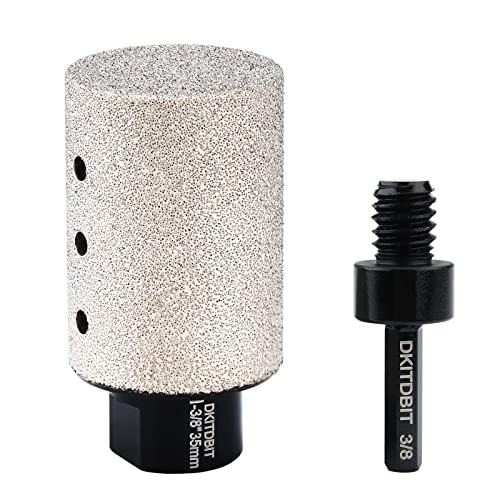
A side cutting flank, with no point at all. A
diamond coated finger bit of 1 and 3
eighths inches for enlarging tile holes publishes 35 millimetres of diameter, a
50 millimetre work length, 65 millimetres overall, a 5/8-11 thread for an angle
grinder with an adapter for a 3/8 inch hex drill, wet or dry use, and 6,000 to 11,000 revolutions a
minute. Its own drawbacks field is the clearest statement of role in this catalogue: "Only for
predrilled holes", and the maker "recommends using it only to enlarge, shape or round predrilled
holes, not to start fresh ones."
That tool has no lips and no point, so none of the arithmetic above applies to it. It is a mill,
and a mill in a hole is located by its own flank bearing against the hole wall. Divide its two
published lengths: 50 over 35 is 1.43 diameters of bearing surface, against a twist
drill's zero in the identical job. That is the entire difference, and it is a published ratio. More
in our
review of the diamond finger
bit, with the wider job in
how to cut a large faucet hole in
tile or countertop.
A pilot that hands over to the kerf. A
2 and 1 eighth inch diamond tile hole
saw with a removable pilot, in a two pack publishes 55 millimetres of diameter, a 3/8 inch diamond
height, a 1 and 3 eighths inch cutting depth, 2 and a half inches overall, and the sequence that
makes it work: start on the guiding pilot, then "a hex wrench lets you take the pilot out and finish
with the diamond rim alone."
Read that as a bearing problem and it is elegant. The pilot provides guidance for exactly as long
as there is no kerf; once a groove exists, the groove is the bushing and the pilot
becomes a liability in the middle of the cut. Five millimetres into a 55 millimetre saw that is 0.091
diameters of bearing, which is modest and is emphatically not zero, and it is the reason the pilot is
removable rather than fixed. Its own honest limit is thermal rather than geometric: "Water cooling is
needed to protect the edge." Details in our
review of the diamond tile hole
saw, and the family view is
how to choose a diamond core
drill bit for tile and stone.
What this says about two other pages on this site
How to use center drill bits for
accurate metal holes says a centre drill "makes a precise starting point, not a finished hole"
and that its cone "keeps larger bits from wandering". Both correct, and the arithmetic above says
what that is worth and where it stops: a conical seat fixes the start, and the following
drill is then unguided for 0.300 of its diameter anyway, because a centre drill cannot bring a margin
with it. A deep, narrow seat buys you the first instant. The rest is still on your hands.
Why an impact driver wobbles by design
reaches the same conclusion from the other end of the tool and says the right thing in four words:
"let the work locate the bit rather than the tool." That is exactly what the three products above do,
each with a different surface.
And on the one case where none of this is needed: in wood, a brad point or a Forstner bit has a
rim that cuts the circumference before the centre removes anything, which means its bearing is the
outside of its own kerf from the first millimetre. The whole margin problem is a steel and masonry
problem because the twist drill's geometry is a steel geometry.
The honest limit, and three things not computed
What is exact: the engaged fraction one minus d over D, the mean radius shift from D over 4 to D
plus d over 4, their product at 0.190, the amplification factor D over D minus d, and the 1.449 ratio
between the two point angles. Those are algebra and they hold for any pair of diameters.
What is reused rather than derived, deliberately: the 0.300 and 0.207 point depth
multipliers come from our own
point depth page, used unchanged so the two pages
cannot disagree. That page also flags the real softness underneath them, and it still applies here:
the 118 degree grind is "the one figure no bit listing we carry states anywhere", so the entire first
column of the thickness table rests on a convention rather than a specification.
What is representative rather than published. The 0.05 millimetre lip height error
is a typical production figure and the amplification result scales directly with it, though the
factor of ten does not depend on it at all. The 20 and 18 millimetre example diameters are
illustrative. And the torque estimate assumes a uniform chip load along the engaged lip,
which is not true: the load falls off near the centre, so drilling from solid is slightly less
torque-hungry than the comparison implies, which makes the 19 percent a mild underestimate and the
instability argument unaffected.
Three things this page deliberately does not compute. It does not compute the number of
lobes or the roundness error of the resulting hole, because that needs the bit's radial
stiffness and the workpiece's clamping, and the second of those is your bench rather than a published
quantity. It does not compute a cutting force in newtons, because no bit listing in
this catalogue publishes a feed rate and a force without a feed is a guess wearing units. And it does
not recommend a technique for making a twist drill behave in this job, because the
honest result of the arithmetic is that the missing thing is a bearing surface, and no amount of hand
pressure is one.
Three numbers to carry. A twist drill is unguided until it is 0.300 of its diameter
deep, so in 1.5 millimetre sheet nothing above 5 millimetres is ever guided. Opening a hole leaves
one minus d over D of each lip cutting, ten percent on an 18 to 20 millimetre step,
which drops the torque to 19 percent and makes the job feel easy. And the same step amplifies the
bit's own grinding error by D over D minus d, a factor of ten, at the exact moment
both of its locating features are gone.
Why a Twist Drill Cannot Enlarge a Hole at a glance
2-1/8" Diamond Tile Hole Saw Bits with Pilot, 2-Pack
cutting faucet holes in tile and countertops
2-1/8 inch size fits faucet holes
Water cooling is needed to protect the edge
Why you can trust this guide
We compared these picks using verified manufacturer specifications, current retailer listings, and patterns in owner feedback, alongside editorial research. We focus on measurable differences such as performance, capacity, usability, and build quality. Pickpedia does not present editorial research as laboratory testing, and we do not claim hands-on testing unless it was actually performed.
Best for self-centering starts in metal and acrylic
8.2/ 10 Pickpedia editorial score
KAKILFOB's 19-piece set brings stepped point drill bits with a storage case for drilling acrylic, steel, brass, and other hardened metals. The stepped design is described as four times sharper, cutting faster with less heat. A 135 degree split point self-centers and starts with less pressure, while the twist flutes lift shavings clear. A blue Onyx oxide coating helps prevent chip build-up.
Best for Refining and enlarging holes in stone and tile
8.6/ 10 Pickpedia editorial score
This diamond-coated finger bit measures 1-3/8 inches (35mm) with a 50mm work length and 65mm total. Advanced diamond coating shapes, enlarges and rounds existing holes in porcelain, ceramic, marble, granite and natural stone. It threads onto 5/8-11 angle grinders, and an included adapter fits 3/8-inch hex drills. Works wet or dry at 6000 to 11000 RPM.
Best for cutting faucet holes in tile and countertops
8.4/ 10 Pickpedia editorial score
This two-pack holds 2-1/8 inch, or 55mm, diamond-tipped hole saws with a removable guiding pilot drill bit. It suits DIYers cutting faucet and fixture holes in ceramic, porcelain, granite, stone, and glass. Each bit offers a 3/8-inch diamond height, a 1-3/8 inch cutting depth, and a 2-1/2 inch total length. Water cooling is recommended for cleaner results.