Pvirbravoo Foldable Heavy Duty Sapling and Root Puller Review
A steel lever puller with a foot pedal that lifts woody stems from a quarter inch to one and three eighths inch, roots included.
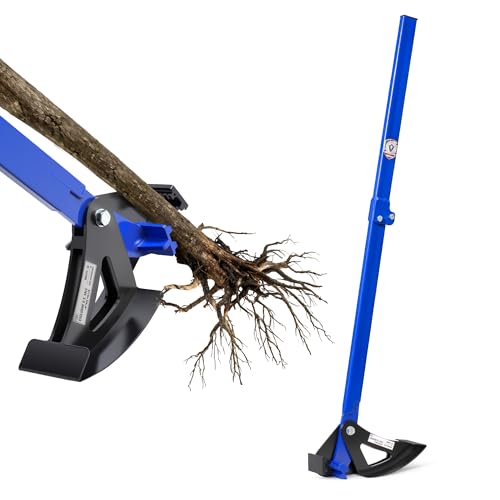
| Brand | Pvirbravoo |
|---|---|
| Stem range | 1/4 in to 1-3/8 in diameter |
| Mechanism | Foot pedal and lever |
| Jaws | Reinforced steel |
| Handles | Anti slip |
| Construction | Heavy duty steel |
| Best for | Invasive woody species, where cutting leaves a stump that resprouts and the root has to come out |
Product Overview
Cutting a woody weed down does not remove it, it prunes it. Most invasive shrubs and vines respond to being cut by sending up multiple new shoots from the stump, so a job that looked finished in spring is worse by autumn, and that is the problem this tool exists to solve.
Pulling the root out is what actually ends the plant, and Pvirbravoo states the tool fully uproots trees, shrubs, vines and thorns with their root systems. That single distinction is worth more than any other feature, because it is the difference between removal and delay.
The stated working range is a quarter inch to one and three eighths inch stem diameter. That is a genuinely useful band: it covers seedling saplings through to established young growth, which is exactly the size range where pulling is both possible and worthwhile.
The tool is also what the listing calls a chemical-free approach, needing no herbicide, no petrol and no high-speed blade. For anyone clearing invasive growth near water, food crops or children, avoiding chemistry is not an environmental gesture, it is a practical constraint.
Score Breakdown
This verdict is based on the manufacturer's stated specifications, the current Amazon listing and its product images, the confirmed materials and design, real buyer ratings, and our research into the product category. Scores are consistent editorial judgments, not laboratory measurements, and we did not receive a paid sample.
Key Features
Cutting prunes a woody weed and most answer a cut stump with several new shoots, so root removal is what actually ends the plant.
Uses leg strength and body weight where pulling by hand loads the lower back at full extension, which bodies do badly.
The jaw has to grip bark hard enough not to slip while the lever multiplies force on it, and slipping is the main failure mode.
A lever generating serious force through wet hands in wet ground needs grip, since losing a loaded handle is how people get hurt.
A quarter inch to one and three eighths inch covers seedling saplings through established young growth, the band where pulling works.
At 55 inches the tool is awkward to store or transport, and folding solves that without affecting how it works.
Matters practically rather than symbolically when clearing growth near water, food crops or children.
A pedal and lever let one person generate force that would otherwise need two people and a rope.
Design and Build Quality
The mechanism is a foot pedal driving a leverage system, and understanding why that matters explains the whole tool. Pulling a rooted stem vertically by hand is one of the least effective ways a human body can apply force, because it loads the lower back at full extension.
A lever converts that into something a body does well. You put weight on a pedal and pull a long handle, which uses leg strength and body weight instead of back and arm strength, and Pvirbravoo frames it correctly as reducing back strain with no bending or digging required.
Jaws are described as reinforced steel, which is the part under the highest stress. The jaw has to bite a bark surface hard enough not to slip while the lever multiplies the force on it, and slipping is both the main failure mode and the main hazard on a tool like this.
Anti-slip handles complete that picture. A lever tool generating serious force through wet hands in wet ground needs grip, because losing hold of a loaded handle is how people get hurt with leverage tools.
The folding design is the practical touch. At 55 inches long the tool is awkward to store or transport at full length, and folding it addresses both without affecting how it works. The stated 14 by 6 inch cross section confirms it is a slim thing once folded.
Performance in Everyday Use
Soil conditions decide the outcome more than anything else. Pvirbravoo mentions tough soil, and the honest picture is that damp soil releases roots far more readily than dry compacted ground. Working after rain is the single biggest improvement you can make to how well this works.
The claim to read carefully is removal without damaging surrounding vegetation or soil structure. Compared with digging or machinery that is fair, since a lever puller lifts along a line rather than excavating. But any root extraction disturbs the soil immediately around the stem, so expect local disturbance rather than none.
One person operation is a meaningful claim and the mechanism supports it. A pedal and a lever let a single person generate force that would otherwise need two people and a rope, which is what makes clearing a boundary or a neglected border a realistic solo job.
The stated upper limit deserves respect rather than testing. At one and three eighths inch you are at the point where stem strength and root mass are both becoming more than a hand lever can overcome, and exceeding it risks the jaws slipping or the stem snapping off at the bite, leaving exactly the stump you were trying to avoid.
Judged for its intended range the tool is well conceived: the right mechanism for the force required, steel where the stress is, grip where the hands are and folding for storage. The specification Pvirbravoo does not publish is weight, which matters on a 55 inch tool carried around a site.
How It Performs: The Evidence
| Decision factor | What we found | Evidence and measurement | Score | Why it matters |
|---|---|---|---|---|
| Root removal | Fully uproots with root systems | Listing states the tool efficiently uproots trees, shrubs, vines and thorns with large root systems | 9.7 | Cutting prunes a woody weed and most respond with multiple shoots from the stump, so only root removal ends the plant |
| Stem capacity | 1/4 inch to 1-3/8 inch diameter | Listing states diameters of 1/4 inch to 1-3/8 inch for the stems it handles | 9.2 | That band covers seedling saplings through established young growth, which is where pulling is both possible and worthwhile |
| Mechanism | Foot pedal with leverage | Listing states it is designed with a foot pedal and leverage mechanism to reduce back strain, with no bending or digging required | 9.5 | A lever converts leg strength and body weight into vertical pull, where pulling by hand loads the lower back at full extension |
| Jaw construction | Reinforced steel jaws | Listing states reinforced steel jaws and anti-slip handles ensure durability and grip even in tough soil conditions | 9.4 | The jaw must bite bark hard enough not to slip while the lever multiplies force, and slipping is the main failure and hazard |
| Grip | Anti-slip handles | Listing states anti-slip handles ensure grip in tough soil conditions | 9.3 | Losing hold of a loaded lever handle in wet conditions is how people get hurt with leverage tools |
| Chemical-free approach | No gas, oil, blades or chemicals | Listing states it works without involving gas, oil, noisy high-speed blades or harmful chemicals | 9.4 | A practical constraint rather than a gesture when clearing near water, food crops or children |
| Transport | Foldable, 55 inches long | Listing describes a foldable tree puller, with item dimensions recording 55 inches by 14 by 6 | 9.3 | A 55 inch tool is awkward to store or move, and folding addresses that without changing how it works |
| Soil claim | Without damaging surrounding vegetation or soil structure | Listing states it quickly removes unwanted plants without damaging surrounding vegetation or soil structure | 7.0 | Fair against digging or machinery, but any root extraction disturbs the soil immediately around the stem |
| Weight | Not published | The listing gives overall dimensions but states no weight for the tool | 4.0 | Weight matters on a 55 inch steel tool that has to be carried around a site between pulls |
Who Should Buy It
- Invasive shrub and vine removal
- Clearing saplings from boundaries and fence lines
- Bramble and thorn removal
- Land clearing and forestry maintenance
- Neglected borders being brought back
- Anyone who cuts woody weeds and watches them return
- Mature trees, established stumps, or soft herbaceous weeds a hand fork would handle
- No weight published for a 55 inch tool
- Upper limit of one and three eighths inch is a real ceiling
- Dry compacted soil makes it much harder work
- Some local soil disturbance is unavoidable
- Wrong tool for soft herbaceous weeds
Full Specifications
How It Compares
| Feature | Pvirbravoo | Typical option | Higher-tier option |
|---|---|---|---|
| What it removes | Stem and root | Top growth only | Stem and root |
| Resprouting | Prevented | Likely | Prevented |
| Force mechanism | Pedal and lever | Arm strength | Lever |
| Back strain | Reduced | High | Reduced |
| Chemicals needed | None | Often | None |
| Stem range stated | Yes | No | Yes |
| Folds | Yes | No | No |
| People needed | One | One | One |
Alternatives Worth a Look


The case for this tool is simple and strong: cutting a woody weed prunes it, and most invasive shrubs and vines answer a cut stump with several new shoots. Taking the root out is what ends the plant, and a pedal-driven lever is the right mechanism because it uses leg strength and body weight where pulling by hand uses the lower back. Reinforced jaws matter because slipping is the failure mode. Respect the one and three eighths inch upper limit.
Frequently Asked Questions
Why pull rather than cut?
Because cutting prunes rather than removes. Most invasive woody shrubs and vines answer a cut stump by sending up several new shoots, so a job that looked finished in spring is worse by autumn. Taking the root out is what actually ends the plant.
What size stems does it handle?
A quarter inch to one and three eighths inch in diameter. That covers seedling saplings through to established young growth, which is the size band where pulling is both physically possible and genuinely worth doing rather than cutting.
What happens if I try something thicker?
Risk the jaws slipping or the stem snapping off at the bite, which leaves you with exactly the stump you were trying to avoid. At the upper limit both stem strength and root mass are already close to what a hand lever can overcome, so respect it.
Why is the foot pedal important?
Because it changes which muscles do the work. Pulling a rooted stem vertically by hand loads the lower back at full extension, which is one of the least effective things a body can do. A pedal and lever use leg strength and body weight instead.
Does soil condition matter?
More than anything else. Damp soil releases roots far more readily than dry compacted ground, so working after rain is the single biggest improvement you can make to how well this tool performs. Pvirbravoo acknowledges tough soil conditions.
Will it damage the surrounding ground?
Some local disturbance is unavoidable. The claim of no damage to surrounding vegetation or soil structure is fair compared with digging or machinery, since a lever lifts along a line rather than excavating, but the soil immediately around the stem will be disturbed.
Can one person use it?
Yes, and the mechanism is why. A pedal and a long lever let a single person generate force that would otherwise need two people and a rope, which is what makes clearing a boundary or a neglected border a realistic solo job.
Is it practical to store?
It folds, which matters at 55 inches long. A tool that length is awkward in a shed and worse in a car, and folding addresses both without compromising how it works. No weight is published, which would be useful to know for carrying it around a site.
This review is based on the manufacturer's stated specifications, the current product listing and its images, the stated stem diameter range, the jaw and handle descriptions, the pedal and leverage mechanism, the stated dimensions, the folding design and the named plant types and users, plus our own research into why cut woody stems resprout, how lever mechanisms convert body weight into vertical pull, and how soil moisture affects root release. It is editorial analysis, not laboratory testing. We have not pulled anything with this tool, and we have noted that no weight is published.